
The Buddhists have a proposition.
It’s not a particularly pleasant one at first glance, and to be honest, I wouldn’t be surprised if there might be those who loathe it entirely, no matter the point at which it is discussed, or encountered.
“Dukkha: the inherent unsatisfactoriness of conditioned existence”, often rendered simply as life is suffering.
It almost epitomises pessimism in its wording and the insinuation behind it. Life, as we know it, and suffering as we know it, or perhaps, how we know it in terms of its potential to reach debilitating heights, and it is often the case that one could have some things going wrong for them, and yet another would simultaneously be having it worse.
In everyday language, pain is synonymous with suffering, or will at least yield some kind of suffering. There are, however, exceptions to this seemingly general rule, those of algolagnia [1] and even hedonic pain [2].
I find myself more concerned with the kind of pain implied by many who will proclaim “I am in pain”, referring to everyday struggles on a psychological level, that is to say, the back and forth between despondency and hope, with possible buoyancy.
Thresholds vary. Two people can face the same tragedy and not be pulverised in equal magnitude, and the only way to build that threshold, either first hand or witnessed in others, is through more exposure to pain than anyone would ask for. Here lies the Buddhist proposition in broad daylight, in the open, for all to see, for all to experience.
Among the many experiences available to us as we wander, ponder the origins and whys of virtually everything around us on this giant blue marble, suffering and pain are part of the essence of our existence. There lies an unspoken futility in asking why me? Whenever mishaps befall the individual. The reflexive counter to this is often why not you? Which will seem to work well and achieve the objective of being a counter, as looking for confirmation for certain things will often lead to many of us finding enough of it to act as evidence.
Because we exist within an environment that cannot be argued against for its way of being, it exists as is by default, does not equate to siding with hopelessness and abandoning the possibility of the opposite of outcomes for unfortunate outcomes.
Nassim Taleb in his book The Black Swan gives a definition of naive empiricism, a succession of anecdotes selected to fit a story and therefore providing this as evidence (except this does not count as evidence). With this in mind, it is possible, and will come off as highly plausible, that one may follow their storyline and find what are the tell-tale signs and occurrences that point to being on the receiving end of misfortune (and pain) that seem to confirm it. Here lies the naivety, the storyline comes first and the evidence follows. And yet, misfortune remains one of several possible outcomes in an uncertain existence, with its occurrence not necessarily making it destined for the individual.
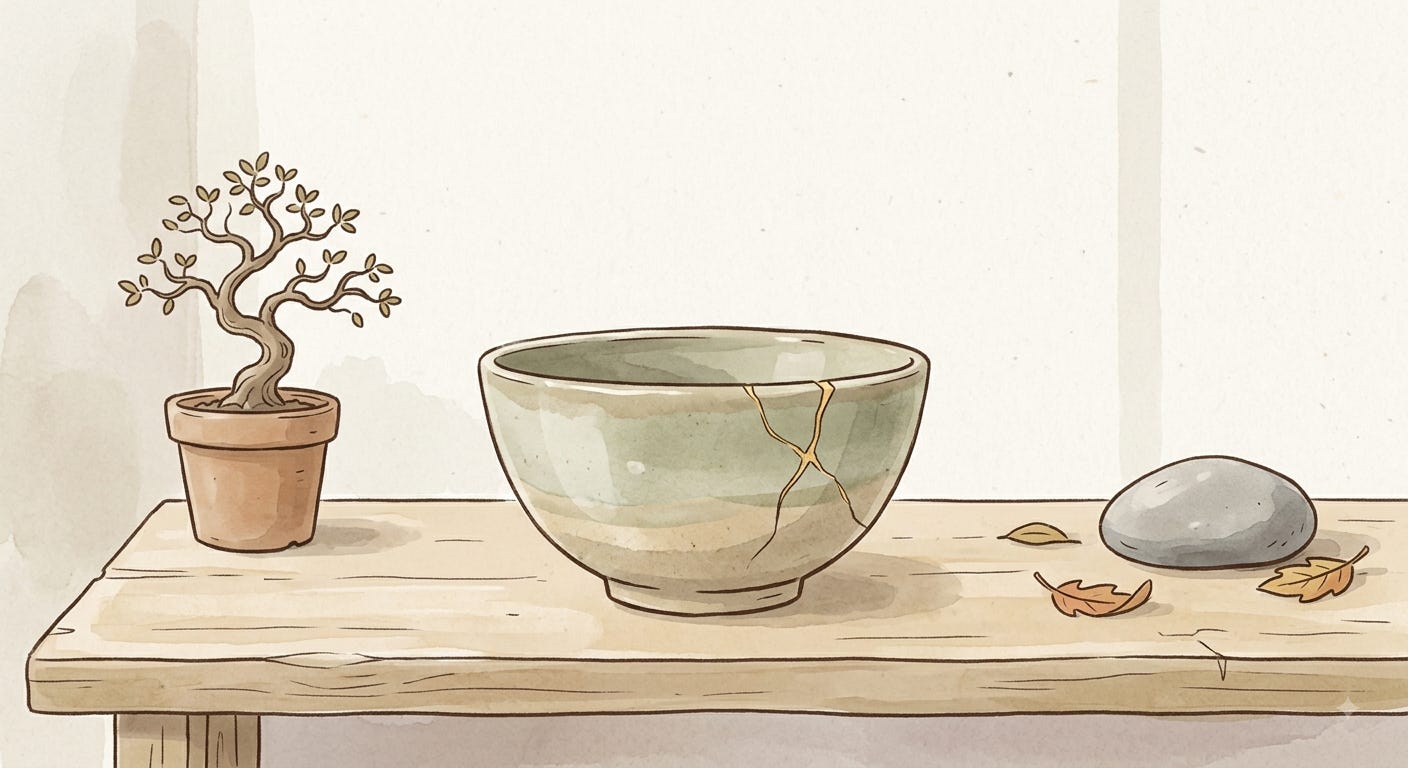
Keeping in mind that there always lies the possibility of finding counter objections for many things, I posit that this Buddhist principle is not to be loathed or feared as the beaming light of impending doom for all, but rather celebrated, in a rather wabi-sabi [3] manner.
The proposition is foundational, its implications varying, its stamps on the psyche several, and its essence, mostly ignored.
However, to ignore the essence of this proposition is not to escape it, it is only to be governed by it unknowingly.
The crack in the bowl is not the failure of the bowl, it is only the part of it that has lived.
Notes:
[1]: sexual arousal or gratification associated with pain
[2]: pain experienced as pleasurable or rewarding.
[3]: beauty in things because they are imperfect, incomplete and fleeting (Japanese aesthetic philosophy)